

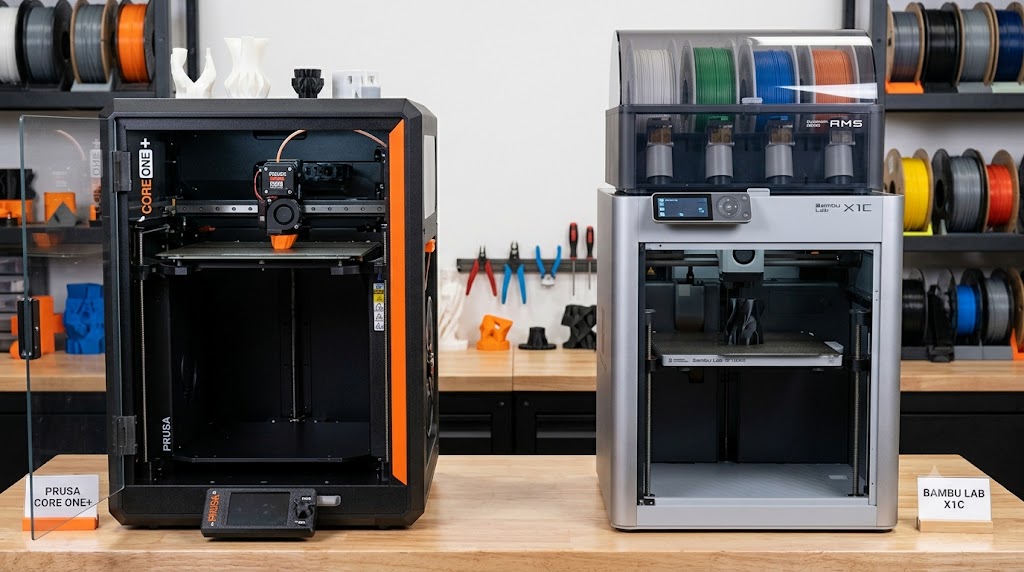
Prusa CORE One vs. Bambu Lab X1 Carbon: A Head-to-Head Comparison
The closest competitor to the Prusa CORE One is the Bambu Lab X1 Carbon. Both printers use a CoreXY motion system, feature enclosed build chambers, and target users who want high-speed, high-quality printing with minimal setup. While the X1 Carbon emphasizes automation and convenience through features like the AMS multi-material system and extensive onboard sensors, the CORE One focuses on repairability, open-source development, and integration with Prusa’s established ecosystem. Their similar build volumes, price points, and performance place them in direct competition.
Prusa CORE One: A More Efficient Approach to Multi-Material Printing

Built for Long-Term Reliability
The Prusa CORE One is designed with long-term ownership in mind, making it a strong choice for schools, professionals, and serious makers. Unlike printers that rely heavily on proprietary parts, the CORE One is built to be maintained, repaired, and upgraded over time. Prusa provides detailed documentation, readily available replacement parts, and strong community support, allowing users to keep their printers running for years instead of replacing them when parts wear out. This focus on serviceability reduces downtime, lowers long-term costs, and makes the CORE One a more sustainable investment compared to printers that prioritize convenience over repairability.
| Category | Prusa CORE One | Bambu Lab X1 Carbon |
|---|---|---|
| Motion System | CoreXY | CoreXY |
| Build Volume | 250 × 220 × 270 mm | 256 × 256 × 256 mm |
| Enclosure | Fully enclosed steel-frame design | Fully enclosed aluminum/glass design |
| Print Quality | Excellent print quality focused on reliable, functional parts | Excellent print quality focused on automation and convenience |
| Multi-Material | Compatible with Prusa MMU3 for multi-material printing | Compatible with AMS for multi-material printing |
| Repairability | Designed to be repaired and maintained by users | Uses more proprietary components, making repairs more difficult |
| Upgradeability | Highly upgradeable with official and community-supported modifications | More limited upgrade options |
| Open Source | Open-source hardware and firmware | Closed ecosystem with proprietary hardware and software |
| Replacement Parts | Widely available with detailed documentation and long-term availability | Available, but many components are proprietary |
| Long-Term Support | Prusa has a strong history of supporting older printers with upgrades and replacement parts | Good support, but less proven long-term support compared to Prusa |
| Customization | Extensive community modifications and user customization | More limited customization options |
| Software | PrusaSlicer with open-source firmware | Bambu Studio with proprietary firmware |
| Cloud Dependence | Can operate without relying on cloud services | Many features are connected to the Bambu ecosystem |
| Networking | Wi-Fi, Ethernet, USB | Wi-Fi, LAN, Cloud |
| Country of Design & Manufacturing | Designed and manufactured in the Czech Republic | Designed and manufactured in China |
| Target User | Schools and professionals | Hobbyists and professionals |
| Maintenance | Easier to troubleshoot, repair, and modify | Easier to operate but harder to service |
| Critical Infrastructure Edition | Built around reliability, serviceability, and long-term use in professional environments | Not Available |
| Best Feature | Long-term reliability, repairability, and ownership freedom | Automation, ease of use, and advanced monitoring |
| Biggest Drawback | Fewer automated features | Less open and more dependent on the manufacturer |
The Prusa CORE One is designed for users who want a reliable machine that can be repaired, upgraded, and supported for years. Its open-source design and strong focus on education, engineering, and professional use make it a better long-term investment for many serious 3D printing users.